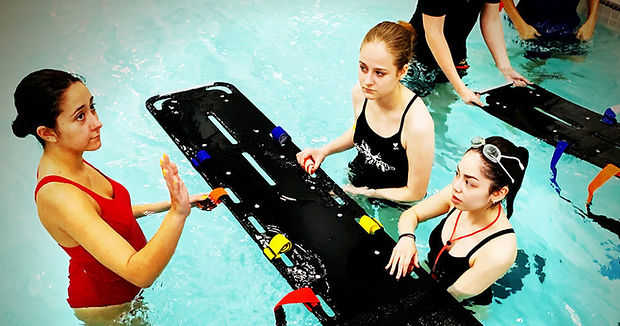
Lifesaving
Aquatic leadership programs train individuals in advanced water safety, rescue techniques, first aid, and communication, serving as the essential pathway to becoming lifeguards or swim instructors.
These courses develop critical decision-making and teamwork skills, preparing participants for careers in emergency services, education, or aquatic management.
1
Canadian Swim Patrol - Rookie, Ranger, Star
The Swim Patrol provides enriched training for those who are ready to go beyond learn-to-swim. Swim Patrol's three levels - Rookie, Ranger, and Star - continue to develop participants' swim strokes and provide the skill foundation that prepares them for success in the Society's Bronze medal awards.
Rookie Patrol (8-10 hr.): Swimmers continue stroke development with 50 m swims of front crawl, back crawl and breaststroke. Lifesaving Sport skills include a 25 m obstacle swim and 15 m object carry. First aid focuses on assessment of conscious victims, contacting EMS and treatment for bleeding. Fitness improves in 350 m workouts and 100 m timed swims.
Ranger Patrol (8-10 hr.): Swimmers develop better strokes over 75 m swims of each stroke. They tackle Lifesaving Sport skills in a lifesaving medley, timed object support and rescue with a buoyant aid. First aid focuses on assessment of unconscious victims, treatment of victims in shock and obstructed airway procedures. Skill drills develop a strong lifesaving foundation.
Star Patrol (8-10 hr.): Swimmers are challenged with 600 m workouts, 300 m timed swims and a 25 m object carry. Strokes are refined over 100 m swims. First aid focuses on treatment of bone or joint injuries and respiratory emergencies including asthma and allergic reactions. Lifesaving skills include defence methods, victim removals and rolling over and supporting a victim face up in shallow water.
5
Junior Lifeguard Club
The Junior Lifeguard Club (JLC) offers a unique aquatic alternative to traditional test-sheet-based aquatic programs and is independent of traditional award progressions. JLC is for quick learners and those between levels or programs who thrive in an energetic learning environment. Members can be any age between 8 and 15 years.
6
Safeguard
Safeguard program (3.5-4 hr.): safety supervision training for guardians (e.g, day camp counsellors, counsellors-in-training and others) who accompany groups of young people to pools or waterfronts. The course stresses the responsibility undertaken by these group leaders for safeguarding the young people in their care even when under lifeguard supervision.
Safeguard focuses on water safety awareness, accident prevention and the principles of aquatic safety supervision. Safeguard teaches participants how to identify hazards and at-risk behaviours, how to recognize potential victims, and how to respond safely in an aquatic emergency.
Safeguard training is designed for swimmers and non-swimmers alike. Successful completion of the course is based on active participation in all sessions and evidence of the Must Sees in each item.
Prerequisite: None. Ideally, guardians are at least 12 years of age, able to swim, and have some lifesaving experience.
2
Bronze Star
Bronze Star (10 hr.): develops swimming proficiency, lifesaving skill and personal fitness. Candidates refine their stroke mechanics, acquire self-rescue skills, and apply fitness principles in training workouts. Bronze Star is excellent preparation for success in Bronze Medallion and provides a fun introduction to lifesaving sport.
Prerequisite: None (Swim Patrol experience recommended.)
3
Bronze Medallion
Bronze Medallion (15 hr.): challenges the candidate both mentally and physically. Judgment, knowledge, skill, and fitness – the four components of water rescue – form the basis of Bronze Medallion training. Candidates acquire the assessment and problem-solving skills needed to make good decisions in, on, and around the water. Bronze Medallion is a prerequisite for assistant lifeguard training in Bronze Cross.
Prerequisite: Minimum 13 years of age or Bronze Star certification (need not be current).
4
Bronze Cross
Bronze Cross (20 hr.): begins the transition from lifesaving to lifeguarding and prepares candidates for responsibilities as assistant lifeguards. Candidates strengthen and expand their lifesaving skills and begin to apply the principles and techniques of active surveillance in aquatic facilities. Bronze Cross emphasizes the importance of teamwork and communication in preventing and responding to aquatic emergencies. Bronze Cross is a prerequisite for advanced training in the Society’s National Lifeguard and leadership certification programs.
Prerequisite: Bronze Medallion and Lifesaving Society Emergency or Standard First Aid certifications (need not be current) or EFA or SFA from one of these approved agencies.